

Live blog: San Diego City Council considers paid parking in Balboa Park
Or: How City Council built themselves an unwinnable policy fight

This is a live blog of my perspective on the San Diego City Council meeting on September 15, 2025, as a San Diego resident, a politics wonk, and an employee in Balboa Park. My views are entirely my own and very open to comment and critique; they do not represent my family, friends, or employer.
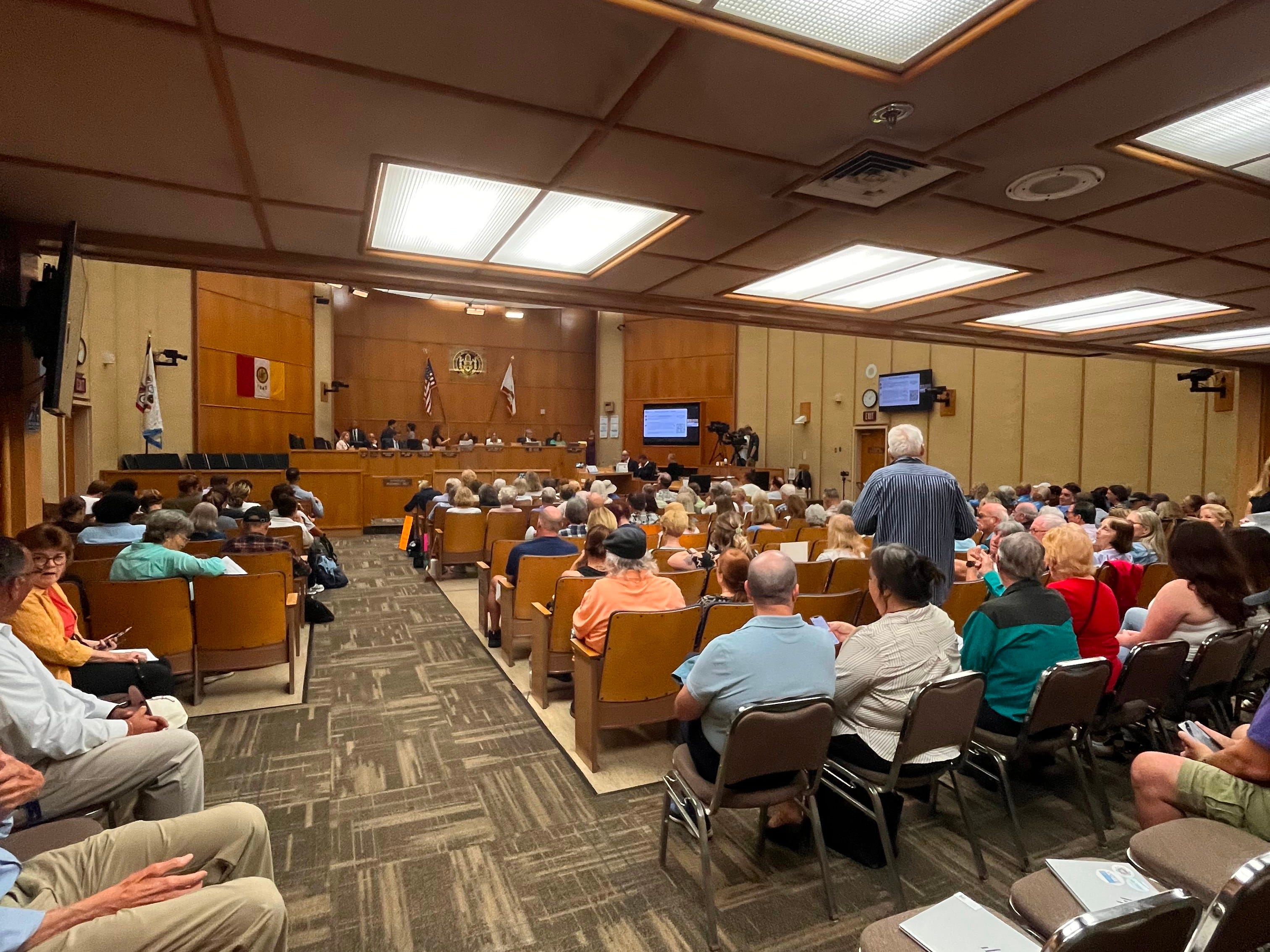
2:00 p.m.: The fullest room I’ve seen at 202 C Street yet. Filled with arts and culture professionals, seniors, the Redwood Bridge Club, youth dancers, and high school students, among others, a typically frigid room overflowed, echoed, and sweltered.
2:15 p.m.: Before we begin in earnest, a comment. The misandrist in me (I’m 27, I’m allowed to be a little bit of a misandrist) feels that men should not be allowed in public if they are unwilling to learn how to whisper correctly. Why am I hearing the bass of your voice as you attempt to hold covert conversations in the back of the standing-room-only Council chambers? (I jest, I jest. Don’t dox me for misandry).
2:16 p.m.: We’ve been called to order. Before we get to the good stuff, though, let’s level out the tone with a deeply bureaucratic presentation about the City Council’s bond issuance obligations so as to avoid actions by the SEC. This is definitely the most important part of the meeting agenda, but I, along with everyone else in the room, do not care.
2:20 p.m.: I wonder how the officials of Allen Park feel being used as the case study for accidentally misleading investors and being investigated by the SEC.
2:22 p.m.: As the lovely city staff continue their very boring yet critical presentation, some background. The City of San Diego has flirted with a structural budget deficit since at least 2008. As the City Council and the Office of the Mayor engaged in the budget process for fiscal year 2026 (beg. July 1, 2025), they faced a massive structural deficit of nearly $250 million. Again, revenues and expenditures have been mismatched on-and-off for decades, but the combinations of the ending of COVID-19 emergency funding, the second Trump administration’s anti-immigration policies and federal funding clawbacks, and the City’s ongoing pension litigation exacerbated the issue in forecasts for FY26.
2:28 p.m.: They’re almost done! Anyway, throughout the spring of 2025, various City leaders attempted to mitigate the deficit largely with one-time actions and increases in revenue generation. The most controversial of these revenue-generating proposals? Paid parking at City owned properties—namely, beaches and the crown jewel of San Diego, Balboa Park.
2:31 p.m.: One of my favorite City Council frequent fliers, “Allegedly Audra,” makes comment regarding the boring informational item. My one response? Marxists don’t generally care about investors, so that’s an odd conflation to toss at the highly market-oriented City Council. I do sincerely appreciate the 4-5 folks who comment at every single meeting—it’s incredible and always an enlightening reflection of thoughts outside of my sphere of influence. Also deserving of a shout-out is the virtual commenter who reminded everyone that San Diego was once called “Enron-by-the-Sea” because of the pension fraud that continues to plague the city balance sheet.
2:36 p.m.: Lots of the most vocal folks in San Diego are entirely disillusioned with this City Council. Beginning with our now-Mayor’s association with ill-fated 101 Ash St. deal while he was on City Council and ensuing settlement as Mayor, extending through pension litigation, more real estate failures, wildly divergent perspectives on housing policy, to now with a variety of recent local issues, the current political class in San Diego has earned intense ire from a small, vocal group of residents. I am not “disillusioned,” per se, but I would like to see a higher caliber of politician in a city this size! It becomes glaringly obvious at these meetings that, despite its size, San Diego’s politicians are not as prepared for their roles as their counterparts in comprable cities may be. To be a bit more blunt—it is clear that most elected officials in San Diego have not had experience in lower-stakes elected offices, so enter City Council out of their depth regarding the breadth of issues requiring significant subject matter knowledge.
2:48 p.m.: We begin! City staff on the frontlines of developing this policy have been put in the line of fire—one of the policy advisors for the Mayor was booed in a Balboa Park Committee meeting, which I found very rude considering that she is not, in fact, setting policy.
2:51 p.m.: City staff is getting into the meat of the proposal now. The gist of the matter is that very few concessions were secured by community groups or local citizens between the initial proposal of the presentation in July and the presentation being given today. A number of comments over the past few months have rejected the plan outright, decrying that the imposition of any barrier to entry to a public park is an inequitable and damaging policy. A much less vocal subset is in support of the plan as currently proposed as a necessary step of the city’s Climate Action Plan to, among other things, drive the City towards more sustainable modes of transportation.
3:06 p.m.: The Office of the Independent Budget Analyst is balanced and consistent. Their comment this afternoon amounts to, in my eyes, saying that the City put themselves in this predicament and that they do, in fact, need to fill the budget hole they left for themselves three months ago.
3:09 p.m.: Public comment, baby! The pinnacle of local civic engagement. I will not summarize all 120 comments (send in some web forms, folks. This meeting is going to be so long.), but I will note the best comments. First, a yeller! Council President Joe LaCava does have a little bit of a paternalistic streak, which is most obvious when he tells public commenters “This is your first warning.”
3:12 p.m.: I am personally of the mind that paid parking is an inevitable future in San Diego. The value of the land is too high for the city to continue to incentivize a car-centric city, and I have been pushed, against my impulses but aligned with statistical evidence and well-reasoned theory, towards the fact that free parking is, in fact, a hidden burden on the city and residents anyway. I love my car! I love my solo commute time. But I also took public transportation as a high school student in Denver ( a very similar city facing a very similar budget deficit), and it provided wonderful, consistent, clean and safe options for me at every age for every event. I’d love to see San Diego transit invested in to a similar level, which requires folks like me to bite the bullet and pay some higher taxes and fees—I just wish the city’s leaders had enough foresight to recognize this and thoughtfully implement a progressive fee structure that works with the needs of residents and ensures the future of Balboa Park.
3:20 p.m.: The current public speaker has identified one of my primary critiques of this specific proposal—it is a recessive tax, “hastily proposed,” being implemented under the guise of parking management but for the express, primary purpose of generating revenue. In fact, the City spokespeople and their collateral materials have continued to tout that this is a policy to benefit the Park and facilitate better parking management, while being explicit both on the dais and in private conversations with stakeholders that this is a revenue-first policy. That is, at best, an unintentional disconnect in messaging; at worst, it’s intentionally obfuscating the intent of the policy proposal to the public.
3:25 p.m.: Peter Comiskey, Executive Director of the Balboa Park Cultural Partnership, has 8 minutes to comment thanks to folks from local cultural institutions ceding time to his comment. Peter and BPCP has made four consistent asks of the City over the three-month development of this plan—lowering all-day fees from $6 and $12 to $5 and $10, respectively; offering a minimum of four hours free parking; free parking for Park volunteers and staff; and rolling out the City resident rates on day one of paid parking. One of these four requests seems to have been incorporated into the current proposal: staff and volunteers have been promoted to level 2 and level 3 lots, instead of just level 3.
3:30 p.m.: Public comment continues. One of the most consistent groups to have organized against this policy: the Redwood Bridge Club. They continue to turn out in huge numbers, signs and all.
3:37 p.m.: Anyway, I think some implementation of paid parking is the future of the park. Some foundational assumptions I hold: A dedicated revenue stream to fund improvements to the park is way overdue, as the City has deferred maintenance for decades. Greenhouse gas emissions from car-based transportation exacerbates climate change, and cities have an obligation to prevent climate change whenever possible. The City of San Diego faces a massive, ongoing structural budget deficit. The City already purchased hardware to implement paid parking, like meters and kiosks. Failure to generate the projected parking revenue will result in mid-year service cuts.
3:45 p.m.: Given those assumptions, I anticipate that this policy will pass today. The City Council isn’t just trapped between a rock and a hard place—they built themselves into a room with rock walls, a granite floor, a concrete roof, and reinforced steel beams throughout. Half the Council seats are up for election next fall. Councilmember Stephen Whitburn, who represents the district that houses Balboa Park, shared in the Balboa Park Committee meeting a few weeks ago that he cannot support the current proposal. This will probably come down to LaCava or Lee changing their votes—Moreno and Campbell are already opposed.
3:52 p.m.: Now, in an appropriate scheduling conflict, I am going to therapy. I hope they’re still talking when I’m done!!
5:14 p.m.: I’m back, and they’re still going :) We have moved to virtual public comment and the commenters continue to passionately ask Council to vote no on item 201. I think there was a missed opportunity for climate action organizations to lobby for thoughtful implementation of paid parking as a critical aspect of city planning for climate change.
5:16 p.m.: Oh, one virtual commenter just said that the City Council, along with the County supervisors and state, are all in alignment on the insidious “not a conspiracy theory, look it up…” United Nations sustainable development goals. That’s a new one for me! Didn’t know those were being treated as a secret plot to disenfranchise people of their cars or whatever.
5:17 p.m.: Oh, and another anonymous coward of a virtual commenter just made some truly heinous, racist comments about Councilmember Sean Elo-Rivera. That was unpleasant.
6:04 p.m.: I went to buy dessert trays off Facebook Marketplace for my wedding and have summarized below my recollections of the comments made while I was driving.
Council President Joe LaCava really has a paternalism problem. When he comments from the dais, there is such a heavy air of condescension towards his constituents thats hard to stomach.
Councilmember Sean Elo-Rivera (I love my home, District 9) is wonderfully principled and consistent. I never doubted that he would move forward, he’s been exceedingly clear about his priorities toward City residents, and I just have this sense that he means well.
Council President Pro Tem Kent Lee is really competent, in my view. He asks the right questions and has a good sense of fiscal responsibility balanced with an equity lens.
Councilmember Jen Campbell is such an interesting politician. She’s termed out as of next fall and had some health issues earlier this year that made her seem more checked-out than she is today. She will not support the proposal if it will be implemented without the resident portal being available.
Councilmember Marni Von Wilpert is the rising star of San Diego politics and I am confident she will flip a redistricted 48th District if voters give her the opportunity. It’s like she was built in a lab to be a darling of the Democratic Party. (If you’re reading this, Von Wilpert campaign staff, hire me.)
I feel awful for the poor Mayor’s Office staffer who was assigned to this project - when pressed by Von Wilpert, she said they have committed to exploring annual passes for all the groups who spoke at City Council in the brief period from now until proposed implementation on Oct. 6, 2025. Von Wilpert seems skeptical, to put it lightly, that all of the discussed commitments will be adequately considered in this timeframe.
When questioned about payment options at the kiosks, City staff confirmed that the kiosks do not accept cash, only coins and credit cards. Notable, given that Von Wilpert led the charge to ensure equity at grocery stores by banning digital-only coupons, and that the kiosks were purchased in July.
A City staffer let slip an interesting sentence, paraphrased “Given the revenue impacts, we didn’t consider that option.” Once again, I am forced to ask—parking management, or revenue generation? Methinks we are misaligned!
6:22 p.m.: We’re going to recess for staff to '“do some calculations.” (There actually might not be a big enough pension in the world to get me to work for this City, which is a testament to why the pensions are such a big deal.)
6:40 p.m.: They’re still on recess, so I went back and detailed some of the previous sections. I do think it’s odd that they didn’t schedule a special session to begin at 1:00 p.m., considering how many public commenters there have been every time this issue has been docketed in the last three months.
7:01 p.m.: We’ve been called back to order! They’re always late, but that was a long recess. Staff and Council have come back with an even more convoluted plan, with possibly no actual alignment. Council President Pro Tem Lee has requested the implementation today be tied to implementation of an annual or quarterly pass becomes available.
7:05 p.m.: Councilmember Vivian Moreno’s first comments of the session—she reiterates her concerns about all of the fee and rate increases facing San Diegans today, and mentions this one has a specific and tangible impact on San Diego residents. I also appreciate that Councilmember Moreno mentions the variety of offerings in the park—not only as a green space and recreation area, but as a unique home of a myriad of cultural institutions. I can’t shake the feeling that Balboa Park is a unique enough asset that it won’t follow established patterns of consumer behavior, so I’m glad to hear that mentioned.
7:09 p.m.: Councilmember Henry Foster III takes a shot at Councilmember Campbell’s assertion that her colleagues passed an “unbalanced budget” in violation of state law. Councilmember Foster asked City staff to confirm, on the record, that yes, they did pass a balanced budget. Feisty!
7:12 p.m.: Councilmember Foster declares, in no uncertain terms, that budget shortfalls encountered today because of backtracking by his colleagues will not be balanced on the backs of district 4, and that he will work with Councilmembers Raul Campillo and Sean Elo-Rivera to ensure it isn’t balanced on the backs of districts 8 or 9 either. My interpretation: the concerns shared today are valid and worth consideration, but the drastic inequities faced by residents in these historically underresourced districts must outweigh the loudest voices in the room.
7:14 p.m.: Whitburn is adamant that the people most affected by this policy will disproportionately be residents of district 3, and he will not support anyone paying to park at the crown jewel of San Diego. The students of San Diego High School and the seniors of the Balboa Park community groups are especially important in his comments here. He also notes that most of his constituents would rather see
7:17 p.m.: Councilmember Von Wilpert notes a realization she had during the recess—Balboa Park is asked to take dual roles as both a centerpiece of local tourism and as a local recreation space for residents. This realization, spurred by public comment (go democracy!) has driven the Councilmember to her current level of support for an adjusted proposal.
7:21 p.m.: Council President LaCava is trying to get a motion on the floor—the goal is to pass the policy contingent on availability of annual and quarterly passes and staff/volunteer placards, while also pursuing short-term solutions.
7:23 p.m.: As the City Clerk drafts the motion, the IBA shares a very high-level fiscal impact of about $1 million if implementation is delayed to January 1, 2026.
7:24 p.m. Councilmember Elo-Rivera takes the opportunity to emphasize his belief that, while action needs to be taken today, he remains committed to finding ways for city residents to stop subsidizing the tourist activities of nonresidents.
7:26 p.m.: Councilmember Whitburn requests and receives clarification that staff will also pursue solutions for the San Diego High School students.
7:27 p.m.: We’re so close! After a few more clarifications, there is a vote on the floor, and it passes, 6-2-1 (Campillo absent).
7:29 p.m.: After 5 1/2 hours of public comment and deliberation, there is paid parking in Balboa Park—kind of. The city has an incentive to get this implemented as close to October 6 as possible to maximize revenue, but there remains a lot to be figured out, and the concessions made today will result in a mid-year budget adjustment a few million dollars wide. I will update with reports from our local papers as they’re made available in case a single person reads this.
Was this at all interesting? Where was I wrong? Are we human? Or are we dancer?
Really valuable coverage in an entertaining and persuasive style. Curious to learn more about the SDGs.
Hire her, Von Wilpert campaign!
Incredible work!