

"is there ANYTHING we can say?"
A case study in desperation fundraising from the DCCC


On February 5, 2026, someone who hates me struck a successful blow in the fight against my sanity by adding me to the DCCC email list. In the twenty-eight days which since elapsed (it took me a couple of days weeks to write this), I received 96 fundraising emails. (Note - as of publishing on March 22, I am sitting at 162 emails.)
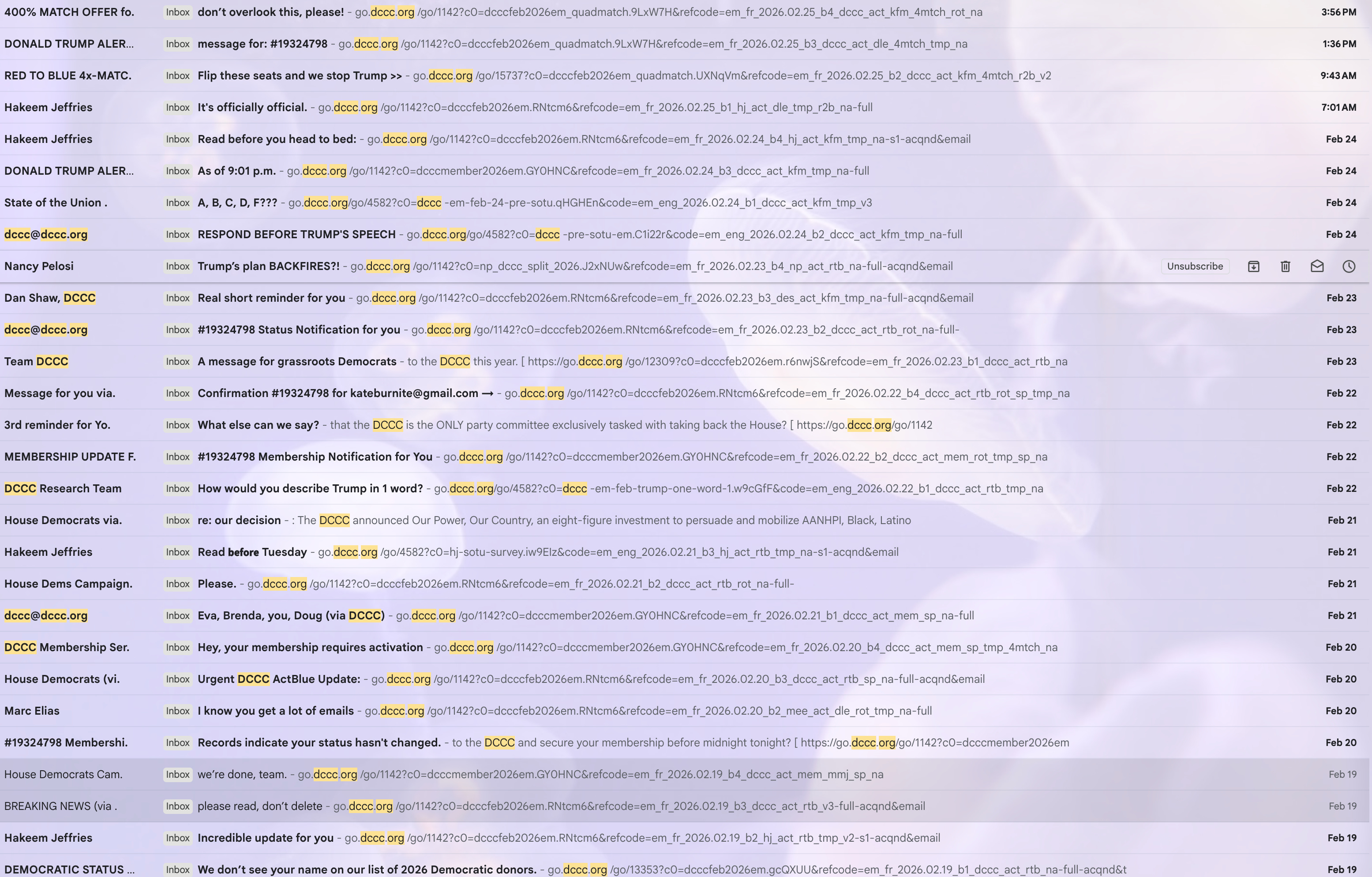
96 emails over 28 days? For the algebraically challenged like myself, that’s a cool 3.5 emails, on average, per day. Every seven hours I can expect a new email, although they sure do stack them during my waking hours. See below for a mere fraction of the unending missives:
AOTD: DCCC
In my new section, AOTD (acronym of the day), I present brief introduction for those blessedly unfamiliar with the dee-triple C:
The Democratic Congressional Campaign Committee is one of the “Hill” committees1, groups of elected leaders within each party who work to elect and re-elect their party nominees. The leader of the DCCC is a House Democrat (the sixth-ranking, apparently? that was news to me) and is currently Rep. Suzan DelBene of the Washington 1st. The Republican House equivalent is the Republican National Congressional Committee, with which I have zero familiarity. I’m sure they’re doing their own nonsense over there, but I like to criticize what I know.
The DCCC recruits candidates to run for the House of Representatives, which means they also raise money to fund the campaigns of those candidates. Out-raising the NRCC feels very important in every election year, but obviously this year feels especially important. I don’t actually know how important it is, so I looked it up—while there is good research demonstrating a relationship between campaign spending and voter outcomes, I couldn’t find anything specifically demonstrating the DCCC wins more seats if it’s better funded than the NRCC in a given election cycle. I sure would like to see this question answered: To what extent does relative success in election cycle fundraising among competitive “Hill” committees impact election success? Sincerely - if the NRCC has raised $500 million and the DCCC has raised $250 million by Election Day, should we expect Republicans to win twice as many seats?
“Of course it’s not that simple, dummy.” Well, sure! That’s my gut instinct too! But I want to see it explored from this direction, because it informs the core of my forthcoming screed:
The DCCC has failed to adequately educate voters about its purpose, so its absurd digital fundraising strategy only serves to hasten the destruction of its trustworthiness, effectiveness, and influence in the public sphere.
Diagram of a Heinous Fundraising Email
First of all, I have to pick one. Given that I have 96 options, much to consider.
Do I select one which utilizes tactics that would be illegal in any just world? Or perhaps one which promises a 400% match that probably doesn’t exist? Maybe one that purports to be a personal plea from Hakeem Jeffries himself!
“All three! All three! ALL THREE!” I hear you chanting in the stands. Noblesse oblige.
Email #50


Sender name: DCCC Membership Services via DCCC
Subject: Hey, your membership requires activation
Content highlights:
An image which appears to be a mock-up of the referenced membership card, featuring the man we apparently anointed king of the party, Hakeem Jeffries. It notes “2026 DEMOCRATIC MEMBERSHIP STATUS: NEVER” in case I wasn’t sure.
DT is “stockpiling "$2 BILLION from MAGA donors,” which a very, very high number that I hadn’t seen in earlier emails—how doth the DCCC propose to overcome such an insurmountable disparity? Maybe you ask Tom Steyer to help and stop hitting me up for $3 every seven hours?
“We hate to beg” seems to be patently untrue. See the “Subject Line Hall of Fame” below.
Questions raised:
I’m sorry, are they fielding a lot of requests from folks who want to be card-carrying members of the Democratic Party?
They would mail me a physical membership card asap? Like, someone on staff would take a portion of the $15 I’d give them to print and mail me a physical card identifying myself as a member of the Democratic Party?
Hey, I don’t have a membership, because that isn’t a thing, so it probably doesn’t require activation. As a deceptive subject line, THIS is a good example of something that would be illegal under the CAN-SPAM Act if we lived in a just world.2
Email #69


Sender name: DONALD TRUMP ALERT via DCCC
Subject: message for: #19324798
Content highlights:
GIANT BOLD RED LETTERS saying “9-HOUR DEADLINE: 400%-MATCH UNLOCKED UNTIL MIDNIGHT”
Red background block of text with a black and white photo of DT. This makes everything extra scary!
In a request “straight from Democratic HQ,” a mysterious entity referred to as “Top Democrats” have “gone ALL-IN on taking back the House—they’ve unlocked a QUADRUPLE MATCH on all contributions until midnight tonight!”
Questions raised:
How on earth could this match be possible? FEC limits on contributions mean it would require a pretty massive group of donors to coordinate their giving
Even if the match was real, why would they leverage a 400% match for an ask of $3? How would anyone know if the match was real?
More important than either of the above: is this transparent marketing ploy effective in raising funds that would not come in using honest tactics? Do those realized funds justify using tactics which broadly deepen distrust of party infrastructure?
Email #77


Sender name: Hakeem Jeffries
Subject: please read, don’t delete
Content highlights:
Full paragraph of bright blue hyperlinked text. Twice! With a big-ass block of bios of people I don’t know in between!
Asking specifically for a $12 contribution and highlighting the Red-to-Blue candidates.
Signed “Keep the faith, Hakeem” including a headshot in case I forgot what he looked like.
Questions raised:
Why is the House Minority leader begging me to open his emails?
Why are we making entire blocks of text hyperlinks?
This is as close to a good email as I’ve received, so the fact that it made the “Heinous Emails” section is telling. 3
Honorary Mentions
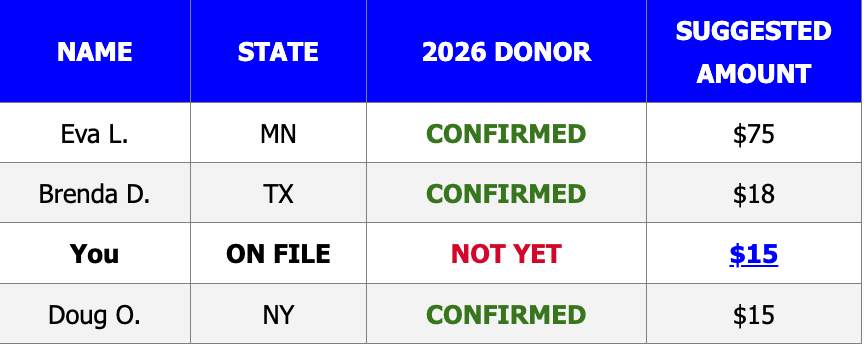
Emails #51 and #98 both feature subject line “Eva, Brenda, you, Doug” in addition to this sick chart:
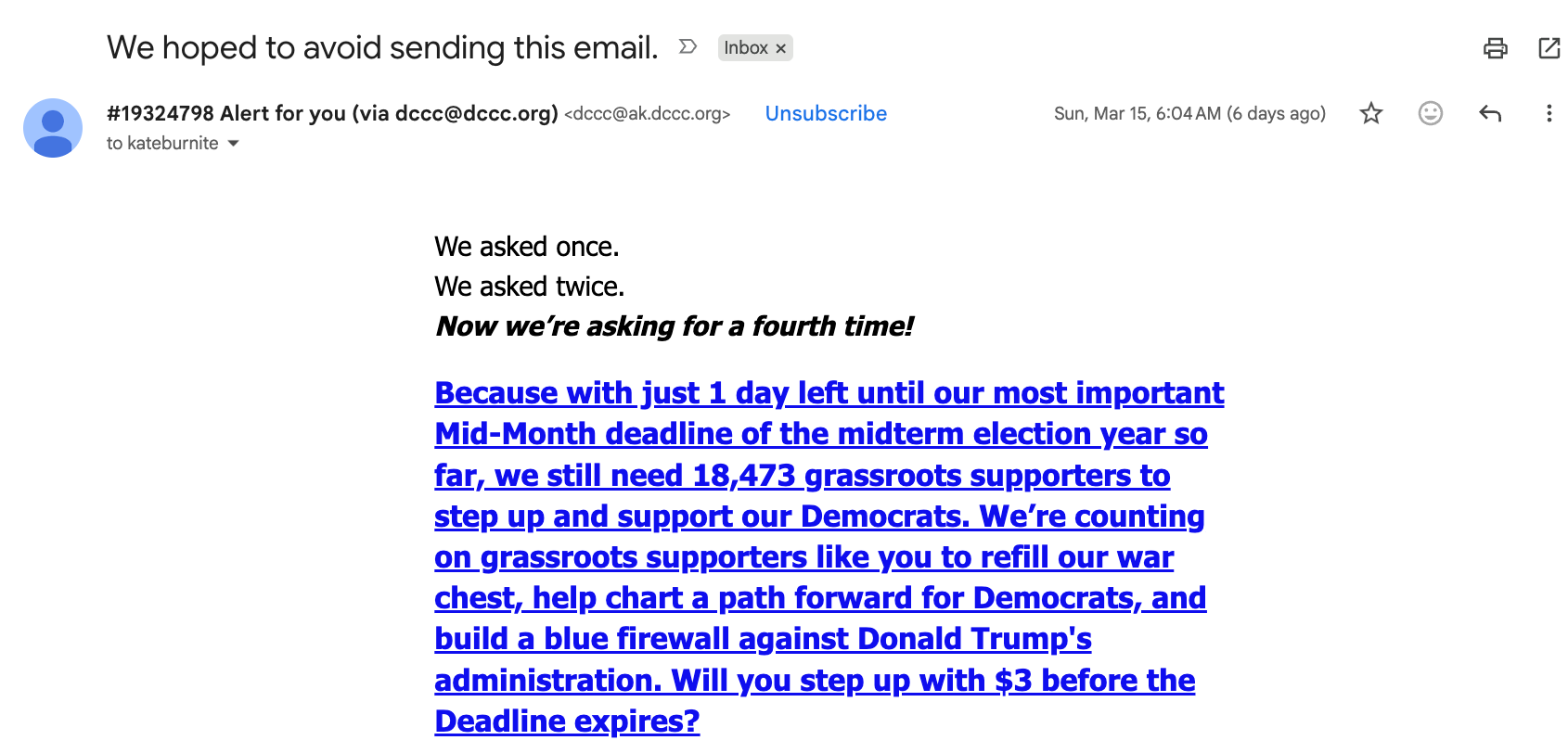
Email #131 is a doozy of a guilt trip, featuring subject line “We hoped to avoid sending this email” and opening with “We asked once. We asked twice. Now we’re asking for a fourth time!”
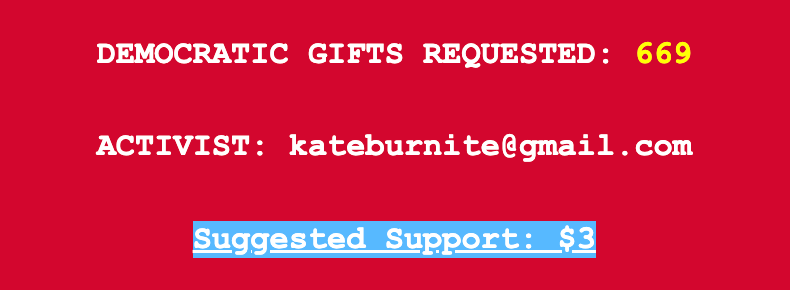
Email #87 provides a similar example of the DCCC’s tendency to include distinctly specific numerical goals in their emails, like requesting 669 democratic gifts of $3 to raise a whopping $2,000.
Subject Line Hall of Fame
Please.4
Pleading with you
re: dummymandering
Support is FALLING drastically
is there ANYTHING we can say?
We’re pleading with you
A, B, C, D, F???
Your $3 support really matters (#19324798)
We don’t see your name on our list of 2026 Democratic donors.
we’re downright BEGGING you
Big Picture from a Big Sample Size
Do these emails answer a single question about what the DCCC is, or what they do, or the value of their work? Honestly, I can’t say for sure—because no one in their right mind would read all of them. If the sampling I took is any indication, then no, there is no helpful information contained within the messages. If that sample isn’t indicative of the mass of the messages, then it is indicative that the throw every possible message to them at every possible opportunity strategy isn’t educating people the way they’d hoped.
RE: The CAN-SPAM Act: Yeah, yeah, I see the argument that all political messages are protected speech, and to that I say: time to grow up, Constitution. The Framers, with their myriad skills and existential faults, did not foresee that every political actor in the country could one day buy some emails and stream hundreds of missives into every single second of their fellow citizens’ waking hours. Even more fundamentally, I do not concede that every legislative remedy at the federal level is unavailable because it would violate the First Amendment, as it would only require content-neutral restrictions on political speech.5
Diagram of an Effective Fundraising Email
Just because I can, I’d like to highlight two political fundraising emails I read that didn’t leave me with a worse perception of the sender than I’d had before.
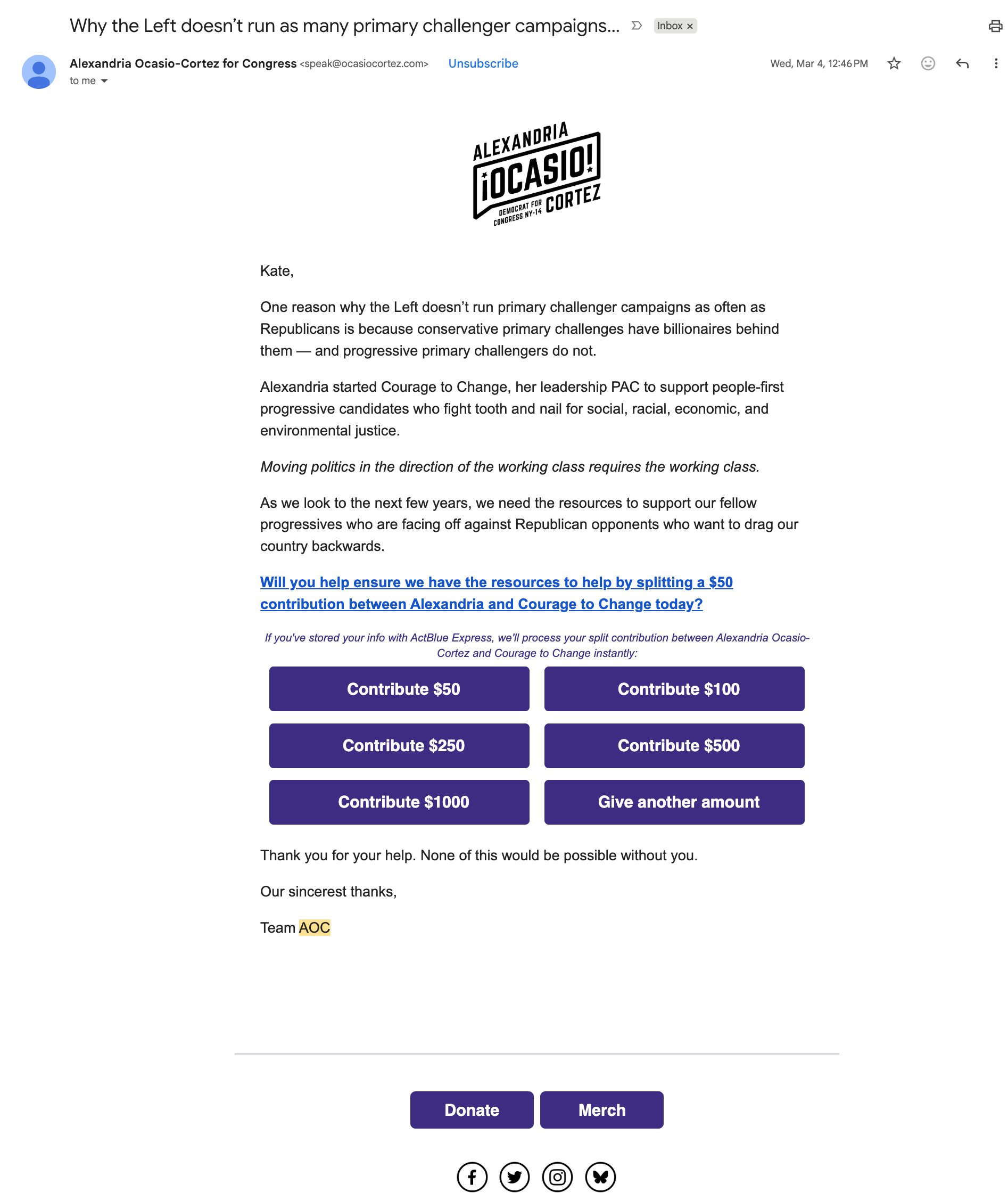
I love this email. I wish I had written this email. It doesn’t hurt my eyes to look at, it doesn’t contain any Randomly Capitalized words, it fits in one screenshot, it offers gift amounts that I know would make an actual difference at scale, it has an incredibly clear story and ask, and I came away having gained something from reading the email—in this case, information detailing the reality of fundraising challenges faced specifically by progressive candidates.
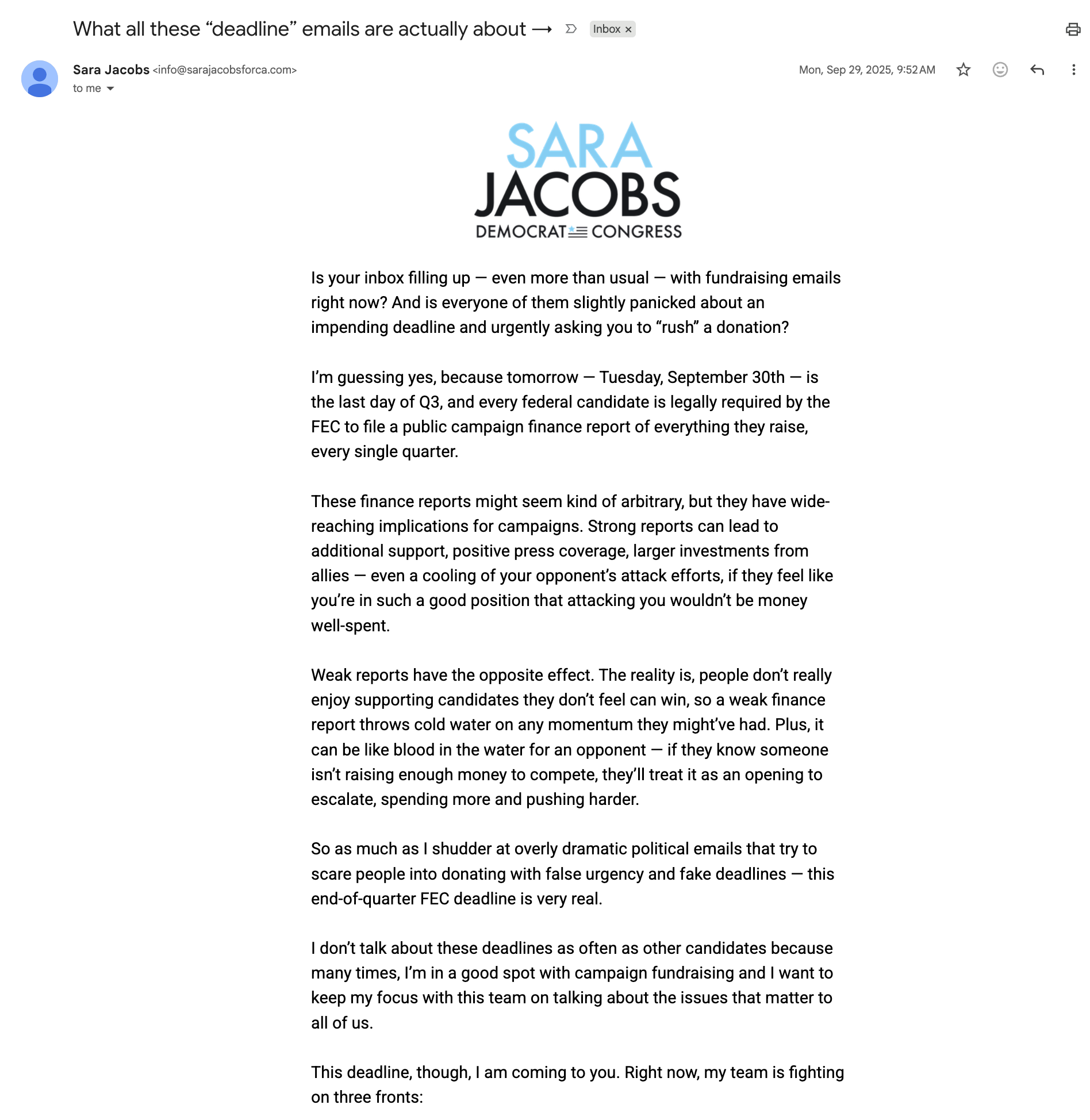
Local to me, I honestly find Rep. Jacobs to be refreshing. Some would think ‘granddaughter of billionaire” should disqualify from any sort of “progressive” label, but her legislative record is pretty solid. What I appreciate most is how she communicates to her constituents, exemplified by the above. Similar to the AOC email, Jacobs goes out of her way to explain to recipients why they’re being asked for money. These two sentences justify my time spent reading the email, because it makes clear a piece of information that is unclear to many:
The reality is, people don’t really enjoy supporting candidates they don’t feel can win, so a weak finance report throws cold water on any momentum they may have had. Plus, it can be like blood in the water for an opponent—if they know someone isn’t raising enough money to compete, they’ll treat it as an opening to escalate, spending more and pushing harder.
How hard would it be, really, to make even one of the four daily emails a bit more informative and a little less “give us three dollars or find your democracy in ashes”?
Opportunities for Improvement
Now, if someone sent me 96 emails about something I believed in, or was interested by, or associated some value with, or informed me of something, or a combination therein, that’s a reasonable number of emails! Alas, the DCCC refuses to accommodate these requests. Instead, they continue to oscillate between oversimplifying and obfuscating reality in a never-ending barrage of self-deprecation and bad graphic design. This is bad for the party’s electoral positioning.
Even those of us who understand Duverger’s Law and who accept, however begrudgingly, that moving the machine of the Democratic Party to the left offers a chance for electoral success along with harm-reducing progressive impact, don’t want to work with the party when they keep pissing everyone off!
These are my top five Very Important Professional Enhancement Recommendations for the DCCC’s digital fundraising team:
Learn from the successful new guard, like AOC and Jacobs. Let go of the legacy strategy and get with the times. Write copy like the recipient is capable of understanding the world in which they live.
Increase the emphasis on the impact of the DCCC. After reading however many of these, I still have no idea of some critical information:
I know how much the NRCC has raised, because they tell me once a day. How much money has the DCCC raised?
How much money do they think they need to raise?
Why should I give to the DCCC instead of, or in addition to, a specific campaign? What makes the DCCC so worthy of my attention and funds as to justify such a massive portion of my inbox?
Who are these Top Democrats with the magic power to unlock 400% matches at will?
I know they have more data about me than they’re letting on. For the love of God, use it. Segment me out of email types I haven’t responded to in the past, target me regionally, use my giving history to vary the ask amounts they’re using—these are all at the ready, just awaiting deployment.
This year, the DCCC needs to be massively dedicated to collecting data so that, in future cycles, they can actually demonstrate why it matters which Hill committee wins the fundraising battle.
Bank some political goodwill across the whole ideological spectrum by legislating against their own fundraising emails. Fix this massive gap in the CAN-SPAM Act and save us from the pain of the ignored unsubscribe.
I’m going to unsubscribe now—it remains to be seen if they’ll listen.
It took me nearly four weeks to finish writing this. Please tell me if you liked it, and, if you didn’t, please tell me that as well, as I need to be knocked down a peg.
Yes, I link directly to Wikipedia. If you still believe, as I once did, that Wikipedia is only ever an unreliable, crowdsourced falsehood-farm: I invite you to reconsider your stance in light of the decades of painstaking work undertaken by your fellow humans to make accessible to the public the sum-total of knowledge shared across space and time. Go read the talk page on something controversial for an example.
Also, if you believe Wikipedia is full of falsity but also believe prediction markets actually offer “this objective, unbiased, filtered source of truth for what the future holds,” your internal decision-making calculus is weak and I don’t want to talk to you until you fix it. Because I am strong and smart and always correct, I am internally consistent in my valuing of public knowledge, and so am better than you.
…but our dear elected leaders in 2003 sure did carve out a beautiful loophole for themselves by deciding political emails are non-commercial.
Telling of the story I want to tell, that is. I’m in charge here.
Clearly, I have outlasted their standard email retention time, because they’re fully recycling emails and subject lines now. I guess it isn’t surprising, since they’re cranking out what appears to be one million emails a day, but you’d think it would give someone pause.
See Van Bergen v. Minnesota. I am clearly not a lawyer.